

Passenger traffic increases by +4.6% in January
Brussels: European airport trade body, ACI EUROPE today released its traffic report for January 2026.
Passenger traffic across the European airport network increased by +4.6% in January when compared to the same month last year.
Airports in the non‑EU+1 market significantly outperformed with +8.8% growth year‑on‑year, whereas those in the EU+ market2 saw volumes expanding by a solid +3.6%.
As is now structurally embedded into the new aviation market dynamics following the COVID-19 crisis, the gains were markedly driven by international passenger traffic (+5.5%), with domestic passengers increasing by +1.8% and remaining -8.1% below pre‑pandemic (2019) levels.
Olivier Jankovec, Director General of ACI EUROPE commented: “January usually gives us the first indication of traffic performance for the year – and the data we published today would normally be seen as evidence of resilient demand and positive prospects for the months ahead. But the conflict which has erupted last week in the Middle East is upending traffic forecasts, making the outlook highly uncertain for now.”
He added: “The Middle East and in particular the Gulf has over the past 20 years become an important part of connectivity and traffic volumes for many European airports – from larger regional ones to major hubs. This is not just about direct connectivity and traffic3 to the Middle East, but also indirect connectivity via that region to Asia-Pacific. This means that even if part of the underlying leisure-driven demand could shift to other destinations or other direct and indirect routings to Asia-Pacific, that traffic is simply not substitutable.”
NATIONAL MARKETS KEEP DIVERGING
As was also the case over the past years, January saw continued disparities in national and individual airport markets performance – reflecting a mix of factors including the primacy of generally resilient leisure demand, the impact of aviation taxes, geopolitics and competitive pressures resulting from increased airline market power.
Within the EU+ market, airports located in the East and/or periphery of the bloc achieved double‑digit passenger traffic growth: Slovakia (+98.0%), Slovenia (+20.8%), Malta (+17.2%), Czechia (+13.5%), Cyprus (+13.3%), Ireland (+13.8%), Bulgaria (+12.6%) and Poland (+11.8%).
At the other end of the spectrum, airports in the Netherlands (-7.3%) where hit by adverse weather, while those in Iceland (-4.3%) and Latvia (-3.2%) faced airline capacity cuts.
Amongst the largest EU+ markets, airports in Italy (+4.1%) posted the best results, followed by those in Germany (+3.5%), Spain (+2.6%), France (+2.1%) and the UK (+2%).
Within the Non‑EU+ market, the highest passenger traffic increases came from airports in Moldova (+35.4%), North Macedonia (+31%), Israel (+24.4%), Uzbekistan (+23.9%), Georgia (+16%), Armenia (+10.3%) and Türkiye (+9.4%).
Meanwhile, airports in Montenegro (-1.7%) and Kazakhstan (+0.1%) significantly underperformed.
ISTANBUL TOPS RANKING FOR ABSOLUTE GROWTH
Istanbul (+6.4%) replaced capacity-constrained London Heathrow (+2.2%) as the busiest European airport in January, welcoming 6.9 million passengers (vs. 6.5 million passengers for London Heathrow), with an average of over 220,000 passengers per day.
In another shift, Madrid (+3.5%) took the third spot from Paris CDG (+0.7%), with the French hub being followed by Amsterdam (-9.1%) whose performance reflects the disruptive impact of severe weather at the beginning of the month.
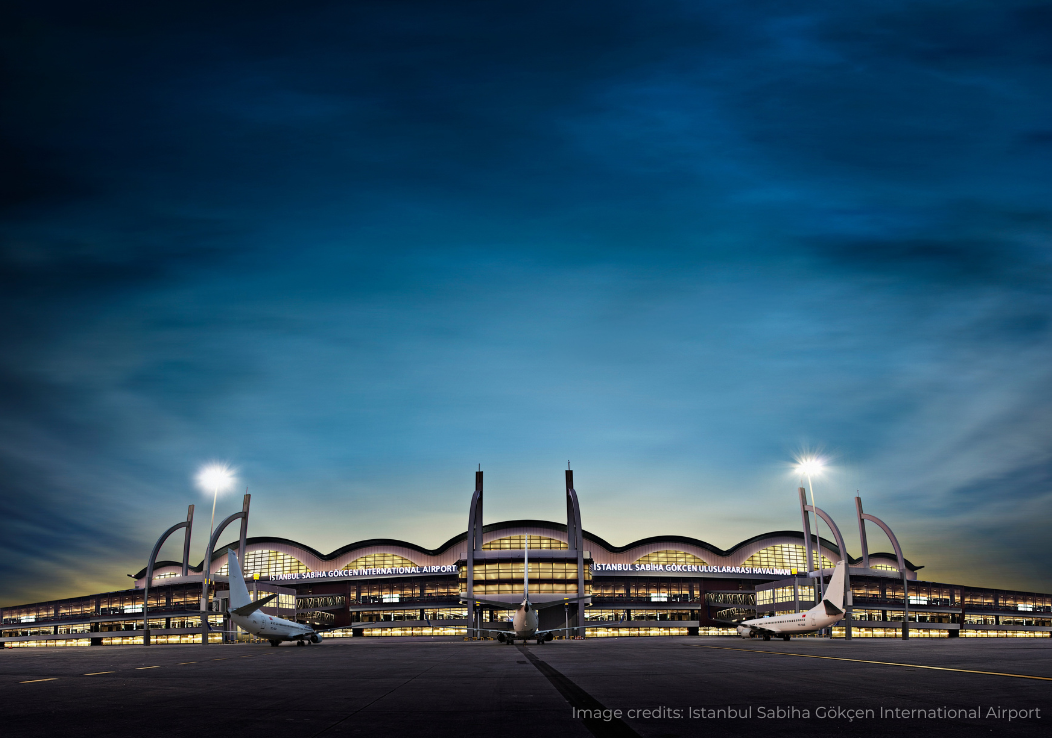
While remaining outside of the top 5 league, Frankfurt (+4.9%) saw dynamic passenger growth. The German hub came in the seventh spot after Istanbul Sabiha Gökçen (+14.3%), which registered the best performance amongst Major airports4.
SMALL AIRPORTS STILL BEHIND PRE‑COVID RESULTS
Small airports (under 1 million passengers) delivered the most contrasted results in January – as was the case throughout 2025. While that segment achieved the best performance overall with an impressive +12.7% growth in passenger traffic when compared to the same month last year, they kept faring the worst when compared to pre‑pandemic (2019) volumes (-28.7%).
Their continued fragility in the new aviation market dynamics is also laid bare in the percent of fully recovered airports within their traffic category. For small airports, less than half managed to fully turn the corner on the impact of the COVID‑19 pandemic (49%).
FREIGHT AND MOVEMENTS
January 2026 saw a dynamic growth in freight traffic at Europe’s airports, with an increase of +6.4% over the same month last year. Amongst the top 10 European airports for freight traffic all but one posted gains year‑on‑year. Liège (+18.1%), Istanbul (+17.1%) and Paris-CDG (+12.5%) saw double digit growth. In absolute terms, Istanbul, Paris-CDG and Frankfurt shifted the biggest volumes of freight in January.
Aircraft movements saw a moderated increase (+1.8%) when compared to January 2025, at the same time still registering in the negatives compared to pre‑pandemic (2019) levels at -6.9%.
DATA BY AIRPORT GROUPS
In January, airports welcoming more than 40 million passengers (Majors), airports welcoming between 25 and 40 million passengers (Mega), airports welcoming between 10 and 25 million passengers (Large), airports welcoming between 1 and 10 million passengers (Medium) and airports welcoming less than 1 million passengers (Small) reported an average change of +2.6%, +4.7%, +6.1%, +5.1% and +12.7% as compared to the preceding year.
The airports that reported the most dynamic growth in passenger traffic versus January 2025 are as follows:
Majors: Istanbul SAW (+14.3%), Istanbul IST (+6.4%), Fraport FRA (+4.9%), Munich MUC (+3.9%), Madrid MAD (+3.5%).
Mega airports: Dublin DUB (+13.8%), Paris ORY (+10.1%), Athens ATH (+8.6%), Zurich ZRH (+6.8%), Antalya AYT (+6.8%).
Large airports: Tel‑Aviv TLV (+24.4%), Tashkent TAS (+21.6%), Malta MLA (+15.1%) Izmir ADB (+16.4%), Krakow KRK (+15.7%).
Medium airports: Bratislava BTS (+127%), Trapani TPS (+45%), Varna VAR (+43.1%), Chișinău RMO (+35.4%), Skopje SKP (+31.4%).
Small airports: Córdoba ODB (+3155.1%), Bucharest BBU (+1020.9%%), Stockholm BMA (+289.3%), Vaxjo VXO (+200.9%), Stockholm VST (+193.6%).
___________________
1 Albania, Armenia, Azerbaijan, Belarus, Bosnia & Herzegovina, Georgia, Israel, Kazakhstan, Kosovo, Moldova, Montenegro, North Macedonia, Russia, Serbia, Turkey, Ukraine, and Uzbekistan.
2 EU, EEA, Switzerland and the UK.
3 The Middle East region accounts for roughly 11% of seat capacity offered at European airports.
4 Airports over 40 million passengers.