

2025 all about traffic resilience as Europe’s airports welcomed an additional 100 million passengers
Brussels: The Full Year 2025 Airport Traffic Report released today by ACI EUROPE confirms the remarkable resilience of air passenger traffic amidst generally lacklustre European economies, inflated airfares, significant supply and capacity pressures, as well as ever volatile and tense geopolitics.
Passenger traffic across the European airport network in 2025 increased by +4.4% when compared to the preceding year – marking a return to “normalised” growth patterns after the bounce back from the COVID-19 pandemic. This resulted in Europe’s airports welcoming an additional 100 million passengers and setting a new absolute record of 2.6 billion passengers.
- Passenger traffic remained on a positive trajectory throughout 2025 with the growth dynamic accelerating in the 4th Quarter at +6.1% – a positive signal for 2026.
- The growth was entirely driven by international passenger traffic which expanded by +5.6%, whereas domestic passenger traffic remained flat at +0.2%.
- Non-EU+ airports1 outperformed the European average, with their passenger volumes expanding by +6.2% compared to +4% at EU+ airports2. This is due primarily to the relative maturity of the EU+ market and the much lower propensity to fly in non-EU+ markets.
- While many European airports broke their passenger traffic records, 41% of them finished the year still below their pre-pandemic (2019) levels as traffic performance variations remained a reality. This reflects increased traffic volatility, airline dominance and consolidation along with renewed competitive pressures upon airports.
Olivier Jankovec, Director General of ACI EUROPE commented: “If anything, last year’s traffic performance is yet another proof that air connectivity is a powerful and largely resilient economic driver, increasingly intertwined with tourism. This reflects the rise of experiential consumption over material consumption – a deep‑seated cross-generational structural shift that is reshaping our economies, and for which Europe is uniquely well positioned. This means aviation is a critical enabler of competitiveness. Yet too many governments and policy makers still fail to connect the dots, and do not treat aviation as the strategic asset it is – especially in the EU.”
Looking ahead to 2026, Jankovec said: “Passenger traffic at Europe’s airports is set to continue expanding this year, with growth expected to further normalise at around +3.3%. Upside potential stems from modestly improving European economic prospects, while travel remains among consumers’ top discretionary spending priorities – even as geopolitics and geoeconomics are likely to further test the sector’s resilience. Many airports are also likely to benefit from Europeans being more prone to travel within Europe rather than externally, while our continent will remain a destination of choice for non–Europeans. Meanwhile, Europe’s airlines are projected to deliver the strongest financial performance globally3, and the supply chain pressures constraining their capacity deployment are expected to somewhat ease. However, infrastructure capacity both on the ground and in the air will remain a key bottleneck. We are especially concerned with the full rollout of the Schengen Entry/Exit System as of April.”
MULTI-SPEED PAN-EUROPEAN AIRPORT MARKET
Within the EU+ market, the growth drivers in 2025 progressively shifted from the South to the East of the bloc, with airports in Slovakia (+20.2%), Poland (+14.4%), Hungary (+11.1%) and Slovenia (+10.7%) amongst the best performers – along with those in Malta (+12.3%) and Cyprus (+10.7%).
Amongst the largest EU+ markets:
- Airports in the UK (+1.7%), France (+2.1%) and Germany (+3.2%) underperformed – notably due to punitive taxation regimes. Germany and France in particular have experienced a drastic fall in domestic passenger traffic when compared to pre-pandemic (2019) levels, respectively at -48% and -27%.
- Airports in Italy (+4.4%) and Spain (+3.9%) generally benefitted from a more supportive environment as regards macro-economic conditions and/or aviation policies.
Meanwhile, passenger traffic declined or remained flat at airports in Iceland (-2%), Latvia and Estonia (both at -0.1%) – in part due to local airlines ceasing or reducing operations4.
Across the non-EU+ market, two factors kept shaping performance in 2025:
- Geopolitics – with airports in Moldova (+46.8%) acting as a gateway for the Ukrainian diaspora, those in Israel (+31.3%) rebounding thanks to security conditions improving, and those in Russia further declining (-9.5%).
- Low-Cost Carriers expansion – notably in the Western Balkans at airports in Bosnia & Herzegovina (+22.2%), North Macedonia (+9.5%) and Albania (+8.7%).
Airports in the major market of Türkiye saw passenger traffic increasing by +5.8%, with the country’s largest airports reporting dynamic growth, while those in Georgia (+14.1%) and Uzbekistan (+10.1%) posted the best performances within Central Asia & the Caucasus.
TOP 5 AIRPORTS BY PASSENGER VOLUMES
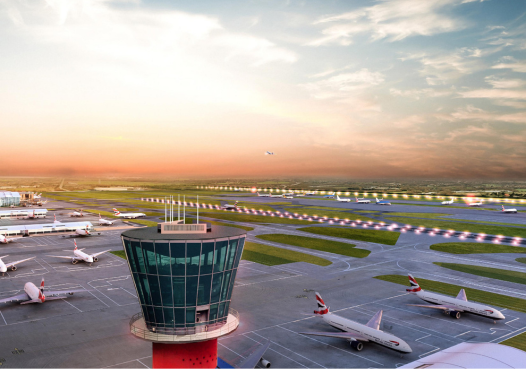
London‑Heathrow once again retained its position as Europe’s busiest airport in 2025, welcoming 84.48 million passengers – an increase of +0.7% over the preceding year thanks to airlines operating larger aircraft into the capacity-constrained British hub.
While remaining in the second position, Istanbul saw its passenger traffic increase by +5.5%, coming short of London‑Heathrow by just 40,000 passengers – with a total 84.44 million passengers. Over the past 5 years, passenger traffic at the Turkish hub has expanded by almost a quarter.
Paris-CDG continued to hold the 3rd position with 72.02 million passengers – an increase of +2.5% over the preceding year. Amsterdam‑Schiphol came in the 4th position with an increase of +2.9% to 68.77 million passengers. The Dutch hub was closely followed by Madrid in the 5th position with 68.12 million passengers and a +3% increase.
Aside from these top 5 airports and amongst the Major airports (over 40 million passengers), Istanbul Sabiha Gokcen’s performance is worth noting as its passenger traffic increased by an impressive +16.7% last year to 48.41 million passengers.
MAJOR AIRPORTS UNDERPERFORMING VS. LARGE & SMALLER ONES
Overall, Major airports underperformed other segments of the airport industry in 2025 with their passenger volumes expanding by +3.5%. Conversely, Large airports (10-25 million passengers) and Small airports (less than 1 million passengers) posted the best results, with their passenger traffic increasing by +5.8% and +6.1% respectively. This reflects a combination of factors including:
- The continued yet selective expansion of Low‑Cost Carriers into both smaller and larger markets with significant route churn.
- The relative retrenchment of Full-Service Carriers on their hubs and a strong focus on premium demand and yields.
- Increasing capacity limitations at Major airports and Mega airports (25-40 million passengers).
But behind the nominal 2025 performance of Small airports, the reality is that they remain the only segment of the airport industry which has yet to recover their pre-pandemic passenger volumes (-33.2% in 2025 vs. 2019).
FREIGHT AND AIRCRAFT MOVEMENTS
Freight traffic across the European airport network increased by +3.2% in 2025 over the previous year – with most of the growth coming from EU+ airports (+3.6%) compared to non‑EU+ airports (+0.4%).
The top 5 European airports for freight traffic were: Frankfurt (1.99 million tons | +2%) replaced Istanbul (1.97 million tons | -0.6%) as the busiest European airport for freight. The Turkish hub was followed by Paris‑CDG (1.92 million tons | +2.3%), London‑Heathrow (1.55 million tons | +0.8%) and Amsterdam‑Schiphol (1.43 million tons | -4.2%).
Amongst the top 10 European airports for freight traffic, the highest best performance came from Liège (+13.9%) and Madrid (+9.6%).
Aircraft movements in Europe were up +3.2% in 2025 compared with the previous year, with a +2.8% increase at EU+ airports and +5.6% increase at non-EU+ airports.
DATA BY AIRPORT GROUPS
The airports that reported the best performance in passenger traffic for the Full Year 2025 compared to the preceding year are as follows:
Majors (over 40 million passengers): Istanbul SAW (+16.7%), Istanbul IST (+5.5%), Barcelona BCN (+4.4%), Munich MUC (+4.4%), Rome FCO (+4.3%).
Mega airports (25-40 million passengers): Milan MXP (+8.6%), Copenhagen CPH (+8.5%), Athens ATH (+6.8%), Paris ORY (+5.5%), Dublin DUB (+5.2%).
Large airports (10-25 million passengers): Tel Aviv TLV (+31.9%), Krakow KRK (+19.5%), Warsaw WAW (+13.2%), Budapest BUD (+11.7%), Izmir ADB (+9.9%).
Medium airports (1-10 million passengers): Chișinău RMO (+46.8%), Trieste TRS (+25.2%), Bratislava BTS (+25.2%), Sarajevo SJJ (+22.2%), Varna VAR (+19.8%).
Small airports (less than 1 million passengers): Bucharest BBU (+572.9%), Burgos RGS (+56.6%), Oradea OMR (+51.9%), Syros Island JSY (+51.1%), Linz LNZ (+45.1%).
___________________
1 Albania, Armenia, Azerbaijan, Belarus, Bosnia & Herzegovina, Georgia, Israel, Kazakhstan, Kosovo, Moldova, Montenegro, North Macedonia, Russia, Serbia, Türkiye, Ukraine, and Uzbekistan.
2 EU, EEA, Switzerland and the UK.
3 IATA press release, 9 December 2025.
4 PLAY Airlines ceased operations in September 2025 | Air Baltic significantly reduced capacity due to engine maintenance delays and supply issues.